Disclaimer
This article is intended solely for educational and informational purposes. It is based on publicly available information regarding the Didcot Power Station Collapse 2016 and does not seek to assign blame, determine liability, or reach legal conclusions about any individual, organisation, or authority. References to the incident are provided as a workplace safety case study to encourage discussion around demolition planning, contractor management, risk assessment, and continuous improvement in occupational health and safety practices. Readers should refer to official investigation reports and relevant regulatory guidance for authoritative information.
Nothing in this article should be interpreted as commentary on the legal responsibility, fault, or conduct of any individual or organisation connected with the incident.
The Didcot Power Station Collapse remains one of the most significant industrial demolition incidents in the United Kingdom, serving as an important reminder of the challenges involved in dismantling large industrial structures. Demolition projects often involve aging infrastructure, changing structural conditions, heavy machinery, and multiple contractors working simultaneously. These factors make careful planning and continuous safety management essential throughout every phase of the project.
The circumstances surrounding the collapse were the subject of official investigations, and this article does not seek to interpret or summarise those findings beyond information already available in the public domain.
On 23 February 2016, a section of the boiler house at Didcot A Power Station in Oxfordshire unexpectedly collapsed during planned demolition activities. The incident trapped workers beneath a large volume of concrete and steel, resulting in a complex emergency response that continued for an extended period. The incident has since been referenced in industry discussions, safety publications, and workplace safety training as an example of the challenges associated with complex industrial demolition projects and the importance of effective planning and contractor coordination.
Understanding the Didcot Power Station Collapse 2016
The Didcot Power Station Collapse 2016 occurred while demolition work was underway on the former coal-fired power station. The boiler house was one of the largest remaining structures scheduled for removal after the station had ceased operations.
Demolition of industrial facilities differs significantly from new construction. Existing structures may have hidden weaknesses, deteriorated materials, unknown modifications, or changing load paths that require continuous assessment. Even carefully planned projects can present unexpected structural behavior as demolition progresses.
Following the Didcot Boiler House Collapse, emergency services, rescue teams, and specialist recovery personnel responded to the site. Rescue efforts were particularly difficult because of the unstable structure and the enormous amount of debris covering the affected area.
The incident illustrates the complexity of managing demolition activities involving large industrial buildings, where structural conditions may change as demolition progresses.
Challenges of Large Industrial Demolition
Every major demolition project presents unique engineering and safety challenges. Unlike construction, demolition removes structural elements that previously provided stability to the building.
During a project such as the Didcot Power Station Demolition, teams typically need to consider:
- Structural integrity assessments
- Sequential demolition planning
- Temporary support requirements
- Worker exclusion zones
- Heavy equipment coordination
- Continuous site inspections
- Emergency response planning
- Communication between contractors
As demolition progresses, the structural behavior of the remaining building may change, making regular reassessment an important part of safe project execution.
Impact on Workers and the Industry
The collapse resulted in the deaths of four workers, deeply affecting their families, colleagues, emergency responders, and the wider construction industry. Beyond the immediate tragedy, the incident prompted extensive discussion across demolition and construction sectors regarding safety planning for high-risk projects.
Industrial demolition often requires specialists from different disciplines to work together, including demolition engineers, equipment operators, scaffold teams, electrical contractors, lifting specialists, and safety professionals. Coordinating these activities effectively remains one of the biggest challenges on complex sites.
The Didcot Power Station Accident reinforced the importance of ensuring that everyone working on-site has access to current information, understands project-specific hazards, and follows established work procedures.
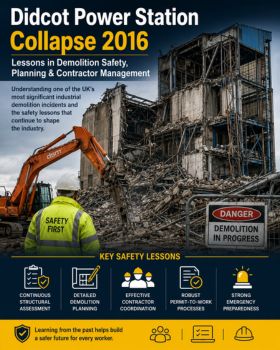
Key Safety Lessons from the Didcot Power Station Collapse
Although every demolition project is unique, several broader safety lessons continue to be discussed throughout the industry.
- Continuous Structural Assessment
Buildings scheduled for demolition may behave differently as structural components are removed. Frequent engineering reviews could help identify changing conditions before they create additional risks.
- Detailed Demolition Planning
Comprehensive demolition sequences can reduce uncertainty by defining the order of structural removal, equipment positioning, exclusion zones, and contingency measures.
- Effective Contractor Coordination
Large industrial sites frequently involve multiple contractors working simultaneously. A structured Contractor management solution could help organisations improve communication, document control, competency verification, contractor onboarding, and visibility of work activities across complex projects. However, no software can eliminate every risk or prevent every incident, and effective safety management continues to rely on competent planning, engineering judgement, and operational oversight.
When contractors have access to consistent procedures and current site information, project coordination may become more effective.
- Robust Permit-to-Work Processes
Many demolition activities involve high-risk tasks, including confined spaces, hot work, working at height, lifting operations, and electrical isolation.
Using Work Permit management software could help organisations digitise permit approvals, maintain better visibility of active work, ensure required authorisations are completed, and improve record keeping for high-risk activities.
Digital permit systems may also support improved coordination when several contractors are working within the same operational area, although they form only one part of a broader safety management framework.
- Emergency Preparedness
Despite careful planning, emergencies can still occur. Clearly defined evacuation procedures, rescue plans, communication protocols, and emergency response coordination remain essential components of high-risk industrial projects.
Regular emergency drills may help ensure that workers understand their responsibilities if unexpected situations arise.
The Importance of Contractor Safety Management
Modern industrial projects often rely on specialist contractors with different areas of expertise. While this brings valuable technical knowledge, it also increases the importance of consistent safety management across the workforce.
A well-implemented Contractor management solution could help organisations:
- Verify contractor competencies
- Manage induction records
- Monitor training compliance
- Track safety documentation
- Improve communication between project teams
- Maintain contractor records in a centralised system
- Support ongoing safety oversight throughout the project lifecycle
Similarly, Work Permit management software could help organisations maintain greater control over hazardous work by ensuring permits are reviewed, approved, monitored, and properly closed before work is completed.
Although digital systems cannot eliminate all risks, they may support stronger safety governance and improve visibility across complex projects.
Why the Didcot Incident Still Matters
Nearly a decade after the Didcot Power Station Collapse, the incident continues to be referenced in discussions about demolition safety, engineering planning, and contractor management.
Construction, demolition, energy, mining, manufacturing, and infrastructure sectors all undertake projects involving aging industrial assets. Lessons learned from previous incidents provide valuable opportunities to strengthen future planning and improve workplace safety practices.
Rather than focusing on assigning blame, the incident continues to serve as a reminder of the importance of continuous risk assessment, effective communication, and careful management of high-risk work.
Every incident studied contributes to broader improvements in engineering practices, safety procedures, and operational planning that may help protect workers on future projects.
Conclusion
The Didcot Power Station Collapse remains one of the most widely referenced industrial demolition incidents in the UK and continues to be discussed as a workplace safety case study. They demonstrate the complexities involved in dismantling large structures and reinforce the importance of detailed planning, structural assessment, contractor coordination, and effective permit-to-work processes.
As industries continue to modernise safety practices, technologies such as Contractor management solution platforms and Work Permit management software could help organisations improve visibility, strengthen compliance, enhance communication, and support safer execution of complex demolition and construction projects.
Learning from past incidents allows organisations to continually improve safety systems while honouring the importance of protecting every worker involved in high-risk operations.
The Role of Digital Contractor Safety Solutions
As industrial projects become more complex, organisations are increasingly adopting digital tools to improve contractor oversight and workplace safety. While no software can eliminate every risk, technology could help strengthen safety processes, improve communication, and provide greater visibility across high-risk worksites.
For example, the mai™ Contractor Portal by EHA Soft Solutions is designed to support organisations in managing contractor information through a centralised platform. The solution could help businesses verify contractor competencies, maintain induction and training records, manage compliance documentation, monitor contractor performance, and improve communication between project stakeholders throughout the project lifecycle.
For high-risk activities, Work Permit management software could help organisations digitise permit approvals, maintain accurate records, improve permit visibility, and ensure work is properly authorised before activities begin. When combined with a structured Contractor management solution, organisations may achieve better coordination between contractors, supervisors, and site management while supporting safer work practices.
Although digital platforms cannot replace sound engineering judgement or experienced supervision, solutions such as the mai™ Contractor Portal from EHA Soft Solutions could help strengthen contractor governance, improve documentation, support regulatory compliance, and contribute to continuous safety improvement across construction, demolition, manufacturing, mining, utilities, and other high-risk industries.
Book your personalized demonstration today
📞 Contact Us
USA: +1 (941) 337-1671
Ireland: (+353) 21 4536034
UK: (+44) 800 8021092
📧 info@sheqnetwork.com