
Disclaimer:
This article is provided for general informational and safety-learning purposes only. It summarises publicly reported information about the 2011 Indiana State Fair stage collapse and should not be considered a complete legal, engineering, regulatory, or incident investigation report. The information should not be used to assign responsibility or determine liability. Organisations should seek advice from appropriately qualified safety, engineering, legal, and regulatory professionals when assessing their own risks, temporary structures, contractors, or emergency procedures.
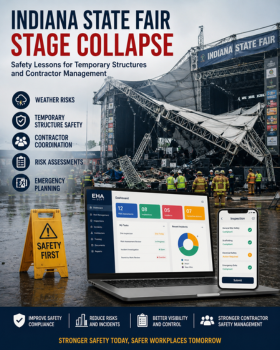
The Indiana State Fair Stage Collapse remains an important case study in event safety, temporary structure management, weather preparedness, and emergency planning. On August 13, 2011, a temporary roof structure associated with the Indiana State Fair Grandstand stage collapsed shortly before a scheduled concert performance. Seven people died and more than 50 others were injured. Following the incident, Indiana occupational safety authorities investigated workplace-safety issues associated with the event. Published safety orders addressed matters including life-safety evaluation, risk assessment, engineering documentation, anchoring, fall protection, and supervision.
The incident is sometimes referred to as the Indiana State Fair Collapse or the Sugarland stage collapse, because the country music group Sugarland was scheduled to perform that evening. While the event was a devastating tragedy, it can also provide valuable lessons for organisations involved in construction, temporary structures, events, facilities management, and contractor safety.
Rather than focusing on blame, examining the event through a safety-management perspective can help organisations understand how multiple controls—weather monitoring, structural assessment, inspections, communication, evacuation planning, and contractor coordination—may work together to reduce risk.
What Happened at the Indiana State Fair?
On the evening of August 13, 2011, severe weather affected the Indiana State Fairgrounds in Indianapolis. Strong winds were present as the temporary roof structure over the concert stage collapsed while people were gathered in anticipation of the performance. Indiana’s Department of Labor later reported that seven people died, including two employees, while numerous others were injured.
The Indiana State Fair disaster provides an important example of how rapidly changing environmental conditions can create serious risks around temporary structures. A structure that may appear stable under normal conditions could face substantially different loads when exposed to strong winds or other severe weather.
This makes weather assessment an important part of event and temporary-structure safety planning.
Why Temporary Structures Require Special Risk Management
Temporary structures such as stages, grandstands, marquees, scaffolding, temporary roofs, platforms, and exhibition structures may be installed for relatively short periods, but their safety requirements can be just as significant as those associated with permanent structures.
Several factors may need to be considered:
- Structural design and engineering calculations
- Ground and soil conditions
- Anchoring and stability
- Installation and dismantling procedures
- Wind and weather conditions
- Load limits
- Inspection requirements
- Worker access and fall protection
- Emergency access and evacuation routes
- Communication between contractors and event management
Following the incident, Indiana occupational safety authorities issued safety orders to several organisations involved in the event. The published safety orders addressed issues including life-safety evaluation, risk assessment, engineering documentation, anchoring, fall protection, and supervision. These matters were subsequently resolved through settlements.
These findings illustrate why temporary structures should not be treated as simple installations. They require structured planning and documented safety controls throughout their lifecycle.
The Role of Weather Monitoring
Weather can become a critical safety variable during outdoor events. Wind speed, lightning, heavy rain, temperature changes, and other environmental conditions may affect whether an event can continue safely.
A robust event safety plan could establish:
- Which weather conditions require increased monitoring.
- Who is responsible for monitoring forecasts.
- What thresholds may require postponement or evacuation.
- Who has authority to stop or suspend an activity.
- How warnings will be communicated to workers, contractors, and visitors.
- Where people should move during an emergency.
The Indiana State Fair Collapse provides a useful safety lesson on why weather monitoring should be connected to clear decision-making procedures rather than being treated as a separate administrative activity.
Contractor Coordination Is an Important Safety Control
Large events often involve multiple contractors, subcontractors, stage crews, security teams, temporary-structure installers, electricians, production companies, and other service providers.
When several parties work on the same site, safety responsibilities can become complicated unless they are clearly defined.
A contractor-management process could help organisations verify:
- Contractor competency and qualifications
- Insurance and required documentation
- Risk assessments and method statements
- Training and induction status
- Inspection records
- Permit requirements
- Emergency contacts
- Corrective actions
- Site-specific safety requirements
The lessons associated with the Indiana State Fair disaster highlight the importance of ensuring that information is shared across everyone involved in a temporary installation or event.
Risk Assessments Should Reflect Changing Conditions
A risk assessment is not necessarily a one-time document. Conditions can change before and during an event.
For example, an initial assessment might consider normal operating conditions, while a later review may need to account for:
- A changing weather forecast
- Increasing wind speeds
- Changes to the structure
- Additional equipment
- Changes in crowd numbers
- Altered access routes
- Contractor changes
- New hazards identified during inspections
Regular reviews could help safety teams identify whether existing controls remain suitable.
This is where digital safety-management systems may provide practical value. EHS compliance software could help organisations centralise risk assessments, inspections, corrective actions, contractor documentation, and safety records instead of relying entirely on disconnected spreadsheets, emails, or paper documents.
Emergency Planning and Evacuation
Another major lesson from the incident is the importance of emergency preparedness.
For large public events, an emergency plan could cover structural failure, severe weather, fire, medical emergencies, crowd movement, power failures, and other foreseeable scenarios.
An effective plan may identify:
- Emergency roles and responsibilities
- Evacuation routes
- Assembly areas
- Communication methods
- Emergency contacts
- First-aid arrangements
- Coordination with emergency services
- Procedures for stopping an event
- Methods for communicating instructions to contractors and attendees
Indiana’s occupational safety guidance has also emphasised the importance of emergency response planning and employee training, noting that well-developed emergency plans can help organise actions during workplace emergencies.
How Digital Safety Software Could Help
Technology cannot eliminate physical hazards, and software alone cannot guarantee that an incident will not occur. However, digital systems could help organisations make safety processes more organised, visible, and traceable.
Health and safety management software could provide a central location for managing risk assessments, inspections, incidents, corrective actions, documents, and contractor information.
For example, a safety team could use a digital platform to:
- Assign risk assessments to responsible personnel
- Record inspection findings
- Track overdue corrective actions
- Maintain contractor documentation
- Monitor training and induction requirements
- Record incidents and near misses
- Create audit trails
- Share safety information across teams
- Review outstanding safety actions before an event
Some modern platforms may also support mobile access, allowing workers and supervisors to record inspections or safety observations directly from the worksite.
The goal is not simply to digitise paperwork. The greater value could come from improving visibility and accountability around safety-critical activities.
EHA Soft could help organisations strengthen their contractor and workplace safety processes through digital safety-management solutions designed to make key safety activities easier to manage and track. Its solutions could support areas such as contractor management, risk assessments, inspections, incident reporting, corrective actions, and safety documentation. By bringing these activities into a central platform, organisations may improve visibility of outstanding actions, maintain better records, and support more consistent safety processes across multiple worksites and contractors.
Lessons for Modern Contractor Safety Management
The Indiana State Fair Collapse provides several broader lessons that may apply beyond entertainment venues.
- Treat temporary structures as safety-critical assets
Temporary does not mean low risk. Structures should be appropriately designed, installed, inspected, maintained, and monitored.
- Connect weather information to action
Forecasts may only become useful when organisations have defined procedures for responding to changing conditions.
- Keep contractor responsibilities clear
Every contractor and subcontractor should understand their responsibilities, reporting requirements, emergency procedures, and site-specific controls.
- Document safety decisions
Important inspections, assessments, approvals, warnings, and corrective actions should be recorded so that safety teams can verify what has been completed.
- Review emergency plans before an event
Emergency procedures should be practical, communicated, and understood by the people expected to implement them.
Turning a Tragedy Into a Safety Learning Opportunity
The Indiana State Fair disaster was a tragic event that affected workers, performers, attendees, families, and the wider community. Any discussion of the incident should therefore remain respectful and focused on learning rather than assigning personal blame.
For today’s organisations, one of the most useful approaches is to examine how risk-management systems could identify hazards earlier, how communication could be strengthened, and how contractor activities could be coordinated more effectively.
A combination of competent personnel, appropriate engineering controls, inspections, weather monitoring, emergency planning, contractor coordination, and effective documentation may create stronger layers of protection.
Digital solutions such as EHS compliance software and Health and safety management software could support these processes by bringing safety information into one accessible system and helping organisations track whether important actions have been completed.
Ultimately, the most valuable lesson from the Indiana State Fair Stage Collapse is that safety management needs to account for changing conditions and multiple interacting risks. Strong preparation, clear communication, continual assessment, and effective contractor oversight could help organisations create safer environments for workers and the public.
For organisations looking to strengthen their approach to contractor and workplace safety, EHA Soft offers digital solutions that could help simplify and centralise important safety processes. From contractor management and risk assessments to incident reporting, inspections, and corrective actions, EHA Soft’s safety software could help teams manage safety information more efficiently and maintain greater oversight of compliance activities. By combining structured processes with digital visibility, organisations could take a more proactive approach to identifying risks, following up on actions, and improving contractor safety management.
Book your personalized demonstration today
📞 Contact Us
USA: +1 (941) 337-1671
Ireland: (+353) 21 4536034
UK: (+44) 800 8021092
📧 info@sheqnetwork.com