Disclaimer
This article is intended solely for educational and informational purposes. It summarizes publicly available information regarding the Champlain Towers South Collapse and related investigations without assigning responsibility or alleging negligence against any individual, organization, or authority. Investigation findings may continue to evolve as additional technical information becomes available. Readers should rely on qualified structural engineers, applicable regulations, and official guidance when making decisions related to building safety, maintenance, inspections, or contractor management.
When a Building Failure Changed Global Safety Conversations
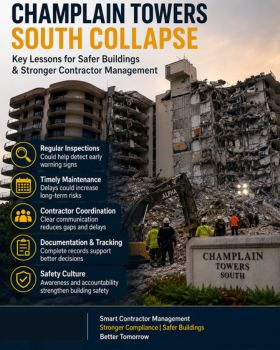
On June 24, 2021, a devastating structural failure struck the Champlain Towers South condominium in Surfside, Florida, claiming the lives of 98 people. Families lost loved ones, rescue teams worked tirelessly for weeks, and communities around the world witnessed one of the most tragic building disasters in recent history.
Beyond the heartbreaking human loss, the incident became a turning point for engineers, regulators, property owners, and maintenance professionals. It prompted a closer look at how aging buildings are inspected, maintained, repaired, and monitored over time. The tragedy also highlighted the importance of timely maintenance decisions, clear communication, and accurate documentation throughout a building’s lifecycle.
While this was not an active construction project, the lessons extend well beyond residential buildings. Any organization responsible for maintaining facilities or coordinating contractors can learn from the findings that emerged after the event.
Rather than focusing on blame, this article explores practical lessons from the Champlain Towers South investigation and discusses how stronger maintenance planning and contractor oversight can support safer infrastructure management.
Understanding What Happened
The collapse occurred during the early morning hours when a large section of the 12-story residential building suddenly failed. Emergency responders launched one of the largest urban search-and-rescue operations in U.S. history as recovery efforts continued for several weeks.
Following the disaster, multiple technical investigations were initiated to understand the sequence of events and examine the conditions that may have contributed to the failure. Publicly available reports have discussed several factors, including:
- Long-term concrete deterioration
- Waterproofing failures
- Corrosion of reinforcing steel
- Moisture intrusion over many years
- Structural conditions identified during engineering inspections
Reports also indicate that major repair work had been identified before the collapse but had not yet started. Investigators continue to evaluate the available evidence, reinforcing an important lesson: structural failures are often the result of several interacting conditions rather than a single isolated issue.
Why This Incident Matters Beyond One Building
Although the Surfside Florida building collapse occurred in a residential condominium, its lessons are relevant across many industries that manage aging infrastructure.
Contractors regularly perform structural repairs, waterproofing, façade restoration, inspections, and maintenance on commercial buildings, industrial facilities, hospitals, educational campuses, and public infrastructure. These activities require close coordination between engineers, property owners, facility managers, and contractors to ensure that inspection findings are communicated clearly and maintenance work is completed effectively.
The incident reinforces the value of:
- Regular structural inspections
- Timely maintenance planning
- Accurate inspection records
- Clear communication between stakeholders
- Well-coordinated repair activities
Strong collaboration cannot eliminate every risk, but it can improve visibility into developing issues and support better decision-making throughout the life of a building.
Key Lessons from the Investigation
The findings examined during the Champlain Towers South investigation offer valuable insights for organizations responsible for maintaining buildings and coordinating contractors. While every structure has unique characteristics, several broader principles can help improve long-term infrastructure management.
1. Regular Structural Inspections Support Early Decision-Making
Buildings naturally experience wear due to age, weather exposure, moisture, and changing environmental conditions. Routine structural inspections help identify developing issues before they become more difficult or costly to address.
Periodic assessments may identify:
- Concrete cracking and surface deterioration
- Corrosion of reinforcing steel
- Water penetration and moisture-related damage
- Waterproofing failures
- Signs of structural movement
Although inspections alone cannot prevent every failure, they provide engineers and property owners with the information needed to evaluate building conditions and determine appropriate maintenance priorities.
2. Delayed Maintenance Can Increase Long-Term Challenges
One of the most important lessons from publicly available reports is the importance of responding to structural concerns within appropriate timeframes whenever practical.
Issues that initially appear manageable may become more complex if maintenance is postponed for extended periods. As buildings age, regular reviews and timely repairs become increasingly important for preserving structural integrity.
Organizations can strengthen maintenance planning by:
- Prioritizing repair recommendations
- Tracking maintenance activities from start to completion
- Reviewing outstanding corrective actions
- Maintaining complete inspection and repair records
A structured maintenance program supports better planning while providing greater visibility into the condition of critical assets.
3. Effective Coordination Improves Project Outcomes
Large maintenance and restoration projects often involve multiple contractors, consultants, engineers, and facility managers working together. Without clear communication, important information may be delayed, duplicated, or overlooked.
Successful coordination depends on:
- Clearly defined responsibilities
- Consistent communication between project teams
- Accessible inspection findings
- Documented maintenance updates
- Shared visibility of project progress
When everyone works from accurate and up-to-date information, organizations are better positioned to make informed decisions throughout the project lifecycle.
4. Accurate Documentation Builds Better Long-Term Knowledge
Every inspection, engineering assessment, repair recommendation, and maintenance activity contributes to a building’s history. Maintaining complete records helps organizations understand how conditions change over time and supports more informed planning for future work.
Well-organized documentation can help teams:
- Review historical inspection results
- Identify recurring structural concerns
- Compare maintenance trends over time
- Support regulatory and compliance requirements
- Improve communication between stakeholders
Reliable records also make it easier to transfer knowledge when project teams, contractors, or property managers change.
5. Risk Assessment Should Be an Ongoing Process
Building conditions are not static. Environmental exposure, renovations, material aging, and operational changes can all influence structural performance over time.
Rather than treating risk assessments as one-time activities, organizations benefit from reviewing changing conditions on a regular basis. This proactive approach helps identify emerging concerns, supports maintenance planning, and improves overall asset management.
An effective risk assessment process may include:
- Periodic structural reviews
- Maintenance planning
- Inspection scheduling
- Repair prioritization
- Environmental exposure evaluations
While every building presents different challenges, continuous evaluation allows organizations to respond more effectively as conditions evolve.
Supporting Better Contractor Management Through Digital Solutions
The lessons from this tragedy extend beyond engineering practices. Organizations responsible for maintaining buildings and infrastructure also need effective systems to manage inspections, contractor documentation, corrective actions, and ongoing maintenance activities.
As projects become more complex, information is often distributed across multiple teams, spreadsheets, emails, and paper records. This can make it difficult to maintain visibility, monitor progress, and ensure that important maintenance activities are completed on time.
A well-designed Contractor management system helps centralize contractor qualifications, inspection records, maintenance schedules, compliance documentation, and corrective actions in one place. By improving access to reliable information, organizations can strengthen collaboration between engineers, facility managers, contractors, and other stakeholders.
Digital platforms do not replace engineering expertise or professional judgement. Instead, they support better organization, improve communication, and make it easier to track activities throughout the maintenance lifecycle.
How Digital Contractor Management Can Improve Oversight
Organizations managing multiple contractors or facilities often need consistent processes for monitoring compliance and coordinating maintenance work. A modern Contractor management software solution can help by supporting:
- Contractor qualification and compliance records
- Centralized inspection and maintenance documentation
- Corrective action tracking
- Scheduled maintenance planning
- Contractor communication and collaboration
- Audit-ready documentation
- Progress monitoring across multiple projects
These capabilities improve visibility throughout the maintenance process and help teams make better-informed decisions using accurate and accessible information.
Practical Takeaways for Building Owners and Safety Professionals
The lessons learned from the Champlain Towers collapse reinforce several best practices that can support long-term infrastructure management:
- Develop long-term maintenance strategies rather than reactive repairs.
- Perform periodic structural assessments using qualified professionals.
- Document inspection findings consistently.
- Track corrective actions until they are completed.
- Maintain clear communication between engineers, contractors, and property managers.
- Review contractor qualifications before work begins.
- Keep maintenance records organized and easily accessible.
- Continuously evaluate risks as buildings and operating conditions change.
Although every structure presents unique challenges, these practices help create a stronger foundation for informed maintenance planning and improved safety management.
Conclusion
The Champlain Towers South Collapse remains a powerful reminder that effective infrastructure management depends on continuous evaluation, timely maintenance, and strong collaboration among everyone involved in the lifecycle of a building.
While the Champlain Towers South investigation continues to contribute valuable technical insights, one of its broader messages is clear: maintaining accurate records, responding to structural concerns promptly, and improving coordination between stakeholders can support better long-term outcomes.
Organizations responsible for managing contractors and maintenance activities may benefit from adopting digital solutions that improve visibility, streamline documentation, and support compliance across projects. A comprehensive Contractor management software solution, combined with sound engineering practices and proactive maintenance planning, can help organizations strengthen oversight and improve operational efficiency.
If you would like to learn how SHEQ Network supports contractor compliance, inspection management, and maintenance coordination, book a personalised demonstration to explore how its solutions can support your organization’s infrastructure management objectives.
Book your personalized demonstration today
📞 Contact Us
USA: +1 (941) 337-1671
Ireland: (+353) 21 4536034
UK: (+44) 800 8021092
📧 info@sheqnetwork.com